

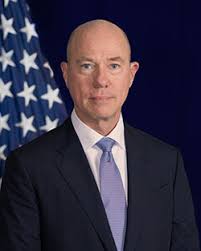
Two weeks after he described the FAA’s traffic management systems as “glorified calculators,” FAA Administrator Bryan Bedford came to Oklahoma City this week to tour the agency’s main Air Traffic Control Training Academy.
Accompanied by U.S. Reps. Tom Cole, Frank Lucas and Stephanie Bice, he toured the academy on Wednesday and got a hands-on overview of controller training programs and the technologies used to prepare the aviation workforce.
The tour included visits to the Tower Simulator System Lab and the En Route Automation Modernization Lab. The FAA Reauthorization Act of 2024 mandated the expansion of tower simulation training across the NAS, requiring all air traffic control towers to have access to a TSS by 2028. Starting in 2027, the FAA will expand the ERAM deployment to Honolulu and Anchorage en route airspace. ERAM receives, processes and displays radar surveillance and flight data, providing controllers with situational radar displays as well as tools and interfaces to interact with that data and each other.
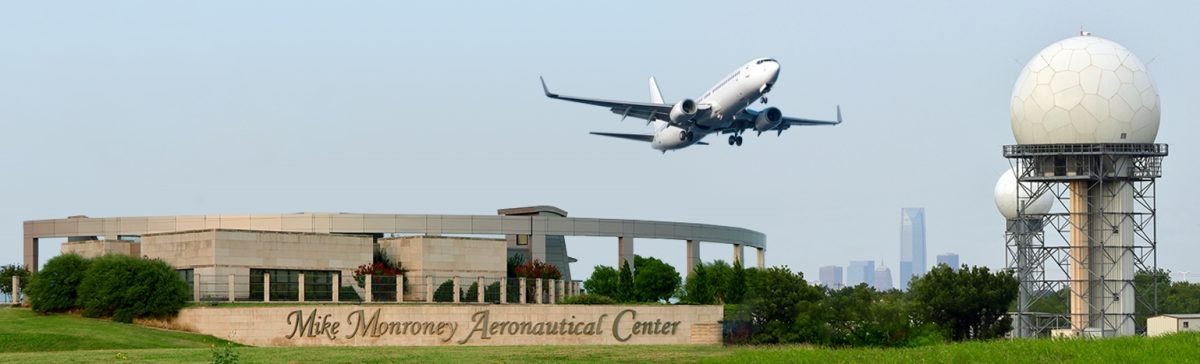
“It was a great day in Oklahoma City with Administrator Bedford as we toured the impressive Mike Monroney Aeronautical Center,” said Representative Lucas.
“The innovative technology that we saw today has, and will continue to, completely change the training curriculum for future aviation experts. This will bring our nation’s opportunities in aviation to new heights, and it will also enable our workforce to be equipped with more skills and services that will only further advance their careers. I’m optimistic about the future of aviation, and I’m proud that this innovation is occurring here in Oklahoma’s third congressional district.”
“I’m grateful to the Oklahoma congressional delegation, including Chairman Tom Cole, Representative Frank Lucas, Vice Chair Stephanie Bice as well as Senators Lankford and Armstrong for their strong leadership here in Oklahoma,” said FAA Administrator Bryan Bedford.
“This center is one of the crown jewels of research and development, and sustainment for the national airspace system. It all happens here. Training new air traffic controllers, technicians, and first and second level engineers. We had the most successful recruiting day in the history of the FAA for our air traffic controllers, we’ve shortened the hiring process and we are getting trainees into the Academy faster than ever.”
“Thanks to the Mike Monroney Aeronautical Center, Oklahoma has long been a hub for aerospace and aviation industry development,” said Representative Cole. “The Center is not only a key administrative, research, and safety hub for the FAA, but it is also home to the FAA Academy, which is the only training center in the country for FAA-certified air traffic controllers. Therefore, it is no exaggeration to say that America’s national aviation industry cannot exist without the workforce the Mike Monroney Aeronautical Center produces – and that was made very clear through the advanced technology and new curriculum we saw on the tour today. I would like to thank FAA Administrator Bedford for taking the time to come out to Oklahoma, as it is critical for the Mike Monroney Aeronautical Center to continue to thrive.”
“It was great to be alongside Administrator Bedford at the Mike Monroney Aeronautical Center,” said Representative Bice. “On his visit, the first by an FAA Administrator in a decade, we witnessed the incredible work happening daily in Oklahoma City. I was proud to see new innovative technologies, funded through the One Big Beautiful Bill, which are helping to prepare future air traffic controllers and the next generation of professionals. Their mission is critical and the Oklahoma delegation is laser focused on providing the support they need.”
A few weeks earlier, Administrator Bedford was highly critical of the air traffic control system throughout the U.S., saying, “We have an analog national airspace system today.”
He joined Transportation Secretary Sean Duffy in delivering an update on their ambitious project to remake American aviation and create what the administration calls the Brand New Air Traffic Control System, or BNATCS. Bedford and Duffy urged Congress to supplement the $12.5 billion it approved last summer to begin modernizing the aviation system. Most of that money is to pay for new equipment and add air traffic controllers.