

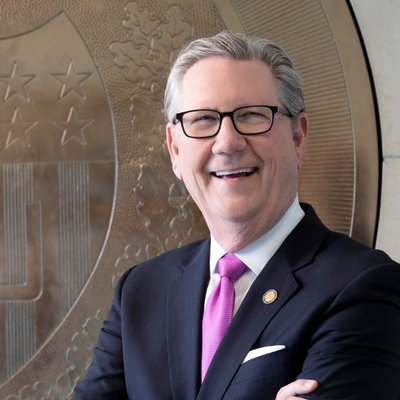
While the nation experiences higher oil prices because of the war against Iran, the head of the Kansas City Federal Reserve Bank believes the growth effects in Oklahoma and the U.S. will be “less severe” than what they endured in the 1970s and 1980s.
Speaking to the Rotary Club of Oklahoma City this week, Kansas City Fed President and CEO Jeff Schmid discussed energy prices, inflation, trends, AI and consumer spending.
“I expect that the growth effects today will be less severe. One important reason is because the economy is now far more energy efficient,” he said when addressing the impact of high crude oil prices.
He explained that in the 1970s, the nation consumed about 12,000 BTUs of energy to produce $1 of GDP but today, the number is close to 3,000 BTUs. Plus, the U.S. has shifted from being an energy importer to being a net energy exporter.
“However, the switch does mean that increased spending on energy is no longer a transfer of money from U.S. energy consumers to foreign energy producers. Instead, it is more akin today to a transfer of money from U.S. energy consumers to U.S. energy producers. Oklahoma City understands this well,” said Schmid in his speech.
”With inflation already running hot, now is not the time to assume that the inflation from higher oil prices will be transitory. At this time, it looks like the economy will absorb a significant increase in oil prices.”
Schmid said with the uncertainty about how the conflict in Iran will unfold, he anticipates oil futures to likely end the year with $80 a barrel while some analysts and businesses are preparing for even higher prices.
“Despite some of these mitigating considerations, I still expect that sustained higher oil prices would be a modest drag on economic growth. Every extra dollar spent on gasoline is one less dollar that households can spend elsewhere, effectively reducing real incomes and weighing on consumption,” said Schmid.
He believes the extra spending on gasoline will flow to domestic energy producers and “could be redeployed on new rigs and other capital expenditures.” But the Federal Reserve Bank CEO also explained many producers are more cautious about chasing higher prices and “are likely to be restrained in their deployment of capital.”
“In the Kansas City Fed’s energy survey, Tenth District producers report needing prices above $75 per barrel to substantially increase drilling. While there is a reasonable probability that futures prices will sustain above those levels, uncertainty about the price outlook could keep many producers on the sideline,” he added.
What is not clear is the effects of the recent rise in energy prices on inflation. He said it’s “less ambiguous.”
“Higher energy prices will increase inflation. Headline inflation figures will be directly affected by higher gasoline prices. However, measures of inflation that exclude energy prices—referred to as core inflation—will increase as well. From food production to delivery and transportation costs to airfares, higher energy prices will also increase core measures of inflation. As I will turn to next, an important role for monetary policy is to ensure that the knock-on effects from higher energy prices on inflation are limited.”
You can read the full speech here.