
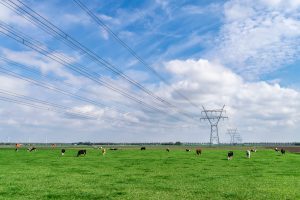
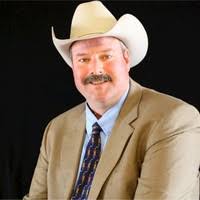
State Senator Casey Murdock has a plan he thinks would help landowners in the Oklahoma Panhandle when it comes to eminent domain and large electric transmission lines. But if challenges made in committee are any indication, the bill could face a rough road when it comes to the full Senate.
He introduced SB1929, a bill that would require utilities and power companies to make payments per foot for crossing a landowner’s property. The bill suggested $2 per linear foot. But Murdock’s bill ran into some opposition when it was narrowly approved last week in the Senate Energy Committee. It was approved on a 6-5 vote but saw resistance from metropolitan legislators who suggested such a law would result in increased utility rates borne by non-landowners.
“This is an idea of maybe moving forward if the landowners are getting a royalty off of the power being pushed across their property, it may make it a little more palatable for someone to have a transmission line go across their property. With that being said, it’s like I said, it’s an idea to start a conversation of a new way to build a transmission line to get landowner buy-in on having that line go across their property,” explained the senator in his presentation to the Energy Committee.
Murdock explained that under his bill, landowners could receive annual payments or “mailbox” payments as he called them.
“As you all are all aware, every time we have a transmission project or a transmission line trying to go in, the fight has been over imminent domain. The ranchers out in my part of the country, I don’t want to give up my land.”
But as the Energy Committee hearing continued, several legislators had critical questions and suggested that non-landowners might be hit with higher costs because of the continuing “mailbox” payments to the landowners.
“You would understand that most of the ratepayers are in three counties, and the burden would fall on those three counties if there is an extra cost to this,” commented Sen. Dave Rader, R-Tulsa.
It led to an exchange with Sen. Murdock.
“You would understand it would be difficult for somebody from those counties to support this if it’s going to cause a rate increase. You would understand that, correct?” asked Sen. Rader.
To which Murdock replied, “ I 100% understand that, my good friend from Tulsa. But me being your good friend from 25% of the entire state, you understand that you flip that light on because and have that ability to have electricity because people in my district have a transmission line that goes across them getting you that power.”
Still, Sen. Shane Jett, R-Shawnee wondered about the continuing costs that would borne by the non-landowners.
“So you’re looking at $10,660 per mile, because that’s two times 5,280. I’m just playing that out. That’s just math. And so that is recurring so that every single year for every mile, someone is going to get $10,000, which would cascade into rate increases because they’re going to just pass the cost on to the rate payers, which are our constituents.”
Murdock pushed against the criticism.
“I just want to start the conversation, and if this idea works, I think landowners, it’ll be more palatable when we’re trying to build these transmission lines, and right now, and not just in Oklahoma, in our country, we have an archaic infrastructure when it comes to transmission in our grid system. We’ve got to start rebuilding our grid system, rebuilding our transmission systems in this country, and that’s where we’re at in reality.”
Murdock said utilities have just started talking to him about the bill.
“I’d be willing to work with utilities, with transmission line companies, what would be a fair rate? My idea is just, if that landowner is getting mailbox money, it’s just going to be more palatable. I don’t know what that rate looks like. I want to visit more with the people that’s actually in the business of what that looks like.”
He said there might be a “win-win” in the bill if it could satisfy challenges from skeptics.
Sen. Rader wasn’t so sure.
“If there’s a win-win in this, I don’t see it right now, but maybe there is. We have a system that’s been working a while, but again, the transmission lines aren’t in my district, so nobody in my district complains about them. The grid is essential to our national defense.”
Sen. Grant Green, R-Wellston, who chairs the Energy Committee was also hesitant to support the measure.
“I’ve got a few things to say. So there was a little bit of pressure for me not to hear this bill, but I thought the conversation absolutely needs to happen. And I’m all about keeping electric prices down, but in the same time, at whose expense?”
Green told committee members the problem of imminent domain could be solved “if SPP would help some and start putting these lines down interstates and turnpikes, that relieves a lot of the problem, relieves a lot of it.”
The title of the bill was stricken prior to the vote which was 6-5 in support.
Supporters were: Sen. Mary Boren, D-Norman; Sen. Spencer Kern, R-Duncan; Sen. Grant Green, Sen. Murdock, Sen. Rader and Sen. Kirsten Thompson, R-Edmond.
Those who voted no were: Sen. Jo Anna Dossett, D-Tulsa; Sen. Avery Frix, R-Muskogee; Sen. Shane Jett, Sen. Tom Woods, R-Westville; and Sen. Julie McIntosh, R-Muskogee.