
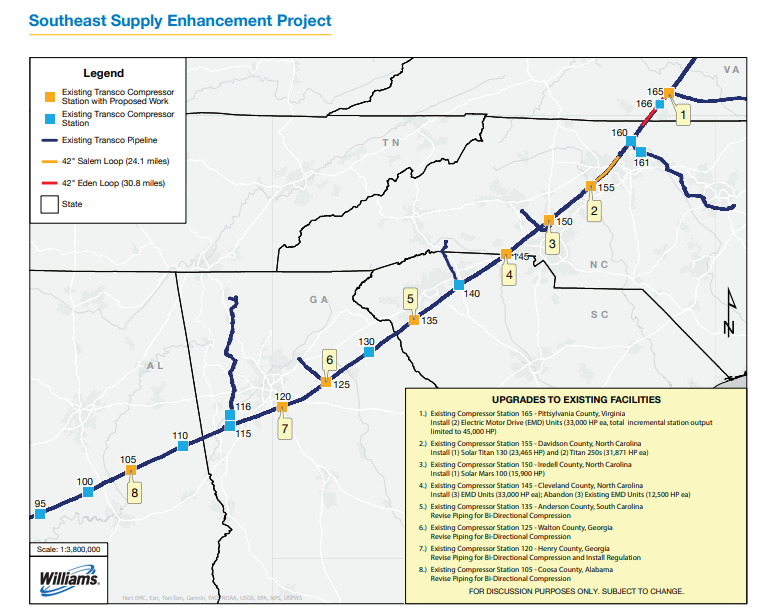
Williams Cos. wants to begin work as quickly as possible on its FERC-approved Southeast Supply Enhancement project, an effort to expand the company’s existing Transco natural gas transmission system along the east coast.
The Tulsa-company recently applied for permission from the Federal Energy Regulatory Commission to begin work and hopes to have bulldozers and other pipelaying equipment at work sometime in March. The filing signals the company’s intent to move quickly from approval to construction as demand for natural gas transportation and power generation fuel continues to rise in Southeast markets.
FERC approval and project scope
In January, FERC approved the Williams project as well as a similar pipeline extension project for Mountain Valley Pipeline. The two projects would be separate but parallel along the same 30-mile route in southern Virginia and North Carolina.
As ConstructionConnect News reported, the two projects will run alongside parts of the extensive Transco gas pipeline system, a critical artery that extends 10,000 miles from South Texas to New York City. The system plays a major role in delivering natural gas to power plants, manufacturers, and residential customers across the eastern United States.
Capacity impact on natural gas supply
“Williams described the project in a Southeast Supply Enhancement Project fact sheet, stating that the pipeline “will add approximately 1.6 million dekatherms per day of pipeline transportation capacity to the Transco system by the fourth quarter of 2027,” reported the construction industry website.
“That amount of gas is equivalent to what is needed to supply approximately 9.8 million homes with natural gas for hot water, heat, and cooking.”
The additional transportation capacity is expected to help utilities and large industrial customers meet rising electricity demand tied to population growth, manufacturing expansion, and the development of new data centers that require consistent fuel supplies for power generation.
Determination of need by regulators
Despite initial concerns about potential redundancy, FERC approved both projects. The commission determined that each developer demonstrated a clear and distinct need for the additional capacity.
Regulators concluded the expansion would strengthen regional reliability and provide more flexibility for delivering natural gas across high-demand markets along the eastern seaboard. Energy planners have increasingly pointed to pipeline capacity as a critical component of maintaining reliable electricity supplies during peak winter and summer usage periods.