
New Mexico, Colorado Join Lawsuit Challenging Trump Energy Emergency Order
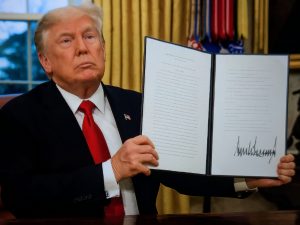
Attorneys General for New Mexico and Colorado are among those who joined a multistate lawsuit challenging President Trump’s “Energy Emergency” executive order, which he signed on his inauguration day invoking the National Emergencies Act.
New Mexico Attorney General Raul Torrez and Colorado Attorney General Phil Weiser were listed among those filing the suit. The states contend the executive order allows federal agencies to bypass or shorten critical environmental reviews to fast-track approval of fossil fuel projects, including a facility that would significantly increase oil traffic along the Colorado River and other sensitive waterways.
States Say Order Misuses Emergency Powers
“Congress passed the National Emergencies Act to prevent presidents from declaring national emergencies for pointless or partisan purposes — exactly what the president has done with this executive order,” Weiser said. “Energy production is at an all-time high. The only energy emergency is the one that is the president’s head.”
Weiser said the use of emergency authorities puts communities and water supplies at risk.
“Derailments, spills, or other accidents from oil trains traveling on rail lines next to our rivers pose a serious risk to the millions of people, businesses, and farms that depend on these critical sources of water,” he said. “We are challenging this made-up emergency to protect our communities and our land, air, and water in Colorado.”
Emergency Procedures Typically Used for Disasters
According to the lawsuit, federal agencies have historically used emergency permitting procedures only during true emergencies, such as hurricanes or catastrophic oil spills, when lives were immediately at risk.
The states argue that agencies are now invoking emergency procedures solely because of the president’s directive, not because of any actual emergency conditions.
Wildcat Loadout Facility at Center of Dispute
The lawsuit points to the Wildcat Loadout Facility, located on Bureau of Land Management land near Price, Utah, as a key example of the alleged misuse of emergency authority.
At the facility, crude oil extracted from the Uinta Basin is transferred from tanker trucks to rail cars for shipment to refineries along the Gulf Coast. Rail cars leaving the Wildcat Facility travel more than 100 miles alongside the Colorado River through Colorado, with some crude oil destined for the Cushing Hub in Oklahoma.
The operator proposed expanding the facility in 2023 but failed to provide BLM with sufficient information to complete a full environmental analysis. As a result, BLM terminated its review.
That proposal was revived in May 2025, just days after the Interior Department published procedures for implementing the energy emergency executive order.
Expansion Approved Without Public Comment
In July 2025, BLM approved the operator’s request for a right-of-way expansion without a public comment period.
According to BLM’s environmental assessment, the expansion would increase oil train traffic from 20,000 barrels per day to approximately 100,000 barrels per day. The expanded project is expected to operate for 20 years.
Despite the projected increase in crude oil shipments, BLM concluded the expansion would not result in significant environmental impacts.
Lawsuit Filed in Federal Court
The updated lawsuit was filed in U.S. District Court for the Western District of Washington. Named as defendants are President Donald Trump, Interior Secretary Doug Burgum, the head of the U.S. Army Corps of Engineers, and the Advisory Council on Historic Preservation.
The states allege the agencies acted unlawfully in implementing the president’s directive and ask the court to declare the executive order illegal and block the use of emergency permitting under it.
States Joining the Lawsuit
Attorneys general joining the lawsuit represent:
Arizona, California, Colorado, Connecticut, Illinois, Maine, Maryland, Massachusetts, Michigan, Minnesota, New Jersey, New Mexico, Oregon, Rhode Island, Vermont, Washington, and Wisconsin.