

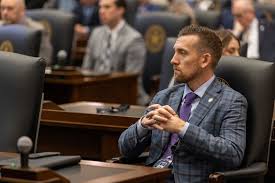
A bill by Rep. Jim Shaw to put tighter restrictions on large load electrical customers, specifically data centers, died in the House Utilities Committee this week when a majority of committee members felt it was infringing on property rights.
Members voted 2-6 against his HB3724, a measure that would have banned taxpayer-funded subsidies for high-demand facilities and prohibited costs to be passed to other retail ratepayers.
“Members, the United States Department of Energy is forecasting by the year 2028 that data centers could comprise of up to 12% of the nation’s total electricity usage. In 2023, that forecast was at 4%,” he explained at the start of the hearing.
Shaw noted his concern that one normal AI data center consumes as much electricity as the city of Edmond which has almost 100,000 people.
What produced opposition to Rep. Shaw’s bill was the section of the bill that declared, “A high-demand facility shall not be constructed, sited, or operated by a foreign principal or on land classified as agricultural land. Any attempt to evade this subsection through the use of shell entities, lease arrangements, or reclassification after the effective date of this act shall be prohibited.”
Some legislators also raised another part of the bill that allowed citizens to conduct an initiative petition if they disagreed with the permitting authority such as a county commission, zoning board or city council.
“Citizens of a county or municipality that are opposed to the
construction, siting, expansion, or operation of a high-demand
facility, as defined in Section 1 of this act, or are in disagreement with the outcome of the vote of a board of county commissioners or city council pursuant to subsection D of Section 1 of this act shall have the powers of initiative and referendum petition as provided for by the Oklahoma Constitution and as provided in this section.”
Rep. Gerrid Kendrix, (R-Altus) raised questions about property rights.
“I am concerned anytime we start infringing on property rights of an individual, if we’ve got a farmer that bought land for a long period of time. At some point in time the state says you cannot use that for this or whatever the case might be, would you agree that that would constitute a taking of property rights from that individual?”

Shaw disagreed.
“I don’t think it’s a taking of a property right. This is not preventing a property owner from selling their property. It’s putting regulation on an industry that is largely unregulated today. That’s that’s what we’re putting in place. And quite frankly, I hear time and time again that county commissioners and city council members are making decisions that run completely contrary to the majority opinion of the people that they serve without any sort of recourse. And that is not OK.”
The issue of property rights, especially agricultural land, was also raised by Rep. Mike Dobrinski (R-Okeene). He also questioned the initiative process if residents didn’t like a decision made by elected officials.
“And in addition to the concern I have about eliminating a rural landowner from being able to participate in something like that, sell their land, lease their land, whatever, the whole initiative process to undo a decision that has been made by a political subdivision prior to that. We have a republic process where elected officials such as you and I make decisions every day based on our constituents. And the initiative petition would create an opportunity where the populace vote would be able to undo something.”
Rep. Mark Chapman (R-Broken Arrow) suggested the bill would “handcuff” communities and the recall process would be “significant overreach” and result in “threats to governing bodies.”
“The way I read some language in this bill, though, quite a few handcuffs on a local community that may decide to do certain things to approve a data center. It’s a statewide blanket approach that tells every community in the entire state they have to adhere by this rule and by these provisions to approve a data center.”
Shaw defended his bill and the initiative process.
“—-so what this is providing is the ability for people that are going to be closest to the project and most closely impacted by the project to have a say in that project because of the impact that these projects and these facilities have on the surrounding community.”
He offered more.
“What we’re acknowledging here with this piece of legislation is that these projects are moving at a speed at which we haven’t seen before. And they’re coming into our areas, oftentimes, you know, without the community knowing about it until it’s at the very last second. So I respect the question, but quite frankly, the decisions that some of these elected officials are making, the citizens don’t have any recourse today before that project actually goes through.”
The bill eventually resulted in a debate in which Rep. Kendrix repeated his concern about “restricting property rights.”
“Mine is less of a debate than more of a statement of kind of where I stand. And I’d support a bill that cleanly prohibits subsidies, that enforces cost causation, and protects ratepayers without restricting property rights.”
Rep. Shaw asked for support of his bill, “ I believe the research is clear and the voice of Oklahomans is clear. They do not want massive industrial complexes in their backyard, or they certainly do not want them so easily shoved through a process completely lacking in oversight and an overall commitment to public health and safety and our constituents’ constitutional right to their pursuit of happiness.”
“The American dream is dying in large part because we treat the people of this state like they’re a piggy bank here to support government action or the growth of big businesses rather than recognizing that it’s the other way around.”
When the vote was taken, Shaw had the support of two Democrats, Reps. Annie Menz of Norman and Arturo Alonso Sandoval of Oklahoma City.