

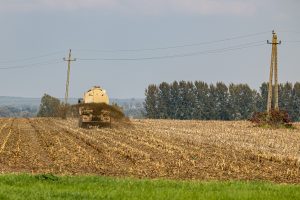
Despite an interim legislative study critical of the use of biosolids on farmland in Oklahoma, members of a state House subcommittee felt there is a need for another 5 years of study.
Two members of the House Appropriations and Budget Natural Resources subcommittee voted against five more years of determining the safety of spreading or farming biosolids into land. Rep. Jim Shaw (R-Chandler) and Rep. David Smith, (R-Arpelar) cash votes against more study of the controversial use of the material.
In questioning the measure, Rep. Shaw declared, “Overwhelming research evidence literature examples of court cases across the country that affirmed over and over that this practice is not OK—do you really think that we need five more years to reaffirm the rest of the country and the rest of Oklahoma?”
The vote was on HB3403 by Rep. Kenton Patzkowsky (R-Balko) who called his bill the Oklahoma Biosolids Land Application Research Pilot Program. Under the bill, a “pilot program” would be created by Oklahoma State University’s Division of Agricultural Sciences and Natural Resources and administered by the Oklahoma Department of Environmental Quality.
Patzkowsky answered Shaw about spending 5 more years to study the biosolids.
“Yeah we need we need whatever it takes to get full confirmation what we got. If it’s something bad it could be as fast as we will move fast and quickly, but—-we gotta find out what Municipalities are ready for a complete shut down day after tomorrow.”
The primary intent of the pilot program would be to identify and approve study plots on agricultural lands, and development of application protocols and the screening of what have become commonly called “forever” chemicals.
B. The Pilot Program shall:
1. Identify and approve study plots on agricultural lands,
including OSU-owned research farms and, as appropriate, cooperating private farms;
2. Develop biosolids application protocols, including:
a. nutrient content evaluation,
b. pathogen and contaminant screening (including
perfluoroalkyl and polyfluoroalkyl substances (PFAS),
heavy metals, and pharmaceuticals),
c. application rates, and
d. soil amendment practices;
3. Conduct agronomic research, including crop yield impacts,
soil health changes, and nutrient cycling;
4. Conduct environmental impact studies, including:
a. surface and groundwater monitoring,
b. soil residual testing, and
c. air quality, odor, and vector considerations;
5. Assess regulatory models, including best management
practices, permitting options,