


Invenergy has apparently put the brakes on the massive 375-mile Cimarron Link transmission line to stretch across northern Oklahoma, citing market conditions. Or the firm is reconsidering how it approaches acquiring land for the massive transmission project.
Responding to an inquiry by OK Energy Today, the Chicago-based energy company’s spokesman explained, “As Cimarron Link development continues, evolving market conditions and grid plans have shown that certain voluntary easement agreements are not necessary for the transmission line to efficiently move power. Cimarron Link development continues and remains focused on building the most efficient infrastructure to deliver reliable and affordable power to the Oklahoma grid.”
It was not a total cancelation of the project as the statement indicated but it also revealed a possible slowdown in the process of moving forward. The reference to “voluntary” easement agreements was not explained and the statement did not elaborate whether the company might proceed with eminent domain to acquire land leases for the citing of its line towers.
The Cimarron Link website had indicated it was advancing “with over half of the required land secured” and Invenergy was aiming for operation in 2028 “amid landowner negotiations and federal funding support.”
In the fall of 2024, the company stated, “Over the last two years, Cimarron Link has engaged landowners and other community members to seek input on project routing and other considerations. By working with landowners to negotiate easement agreements, Cimarron Link has now acquired over half of the rights-of-way for the project. Cimarron Link has also invested in communities by sponsoring local events and organizations, and by developing a Cimarron Link high school scholarship and community grant program.”
Invenergy had boasted the electric transmission project would “unlock access to one of the lowest-cost, steadiest-producing natural energy resources available anywhere in America—the inexhaustible wind energy of the Oklahoma Panhandle.”
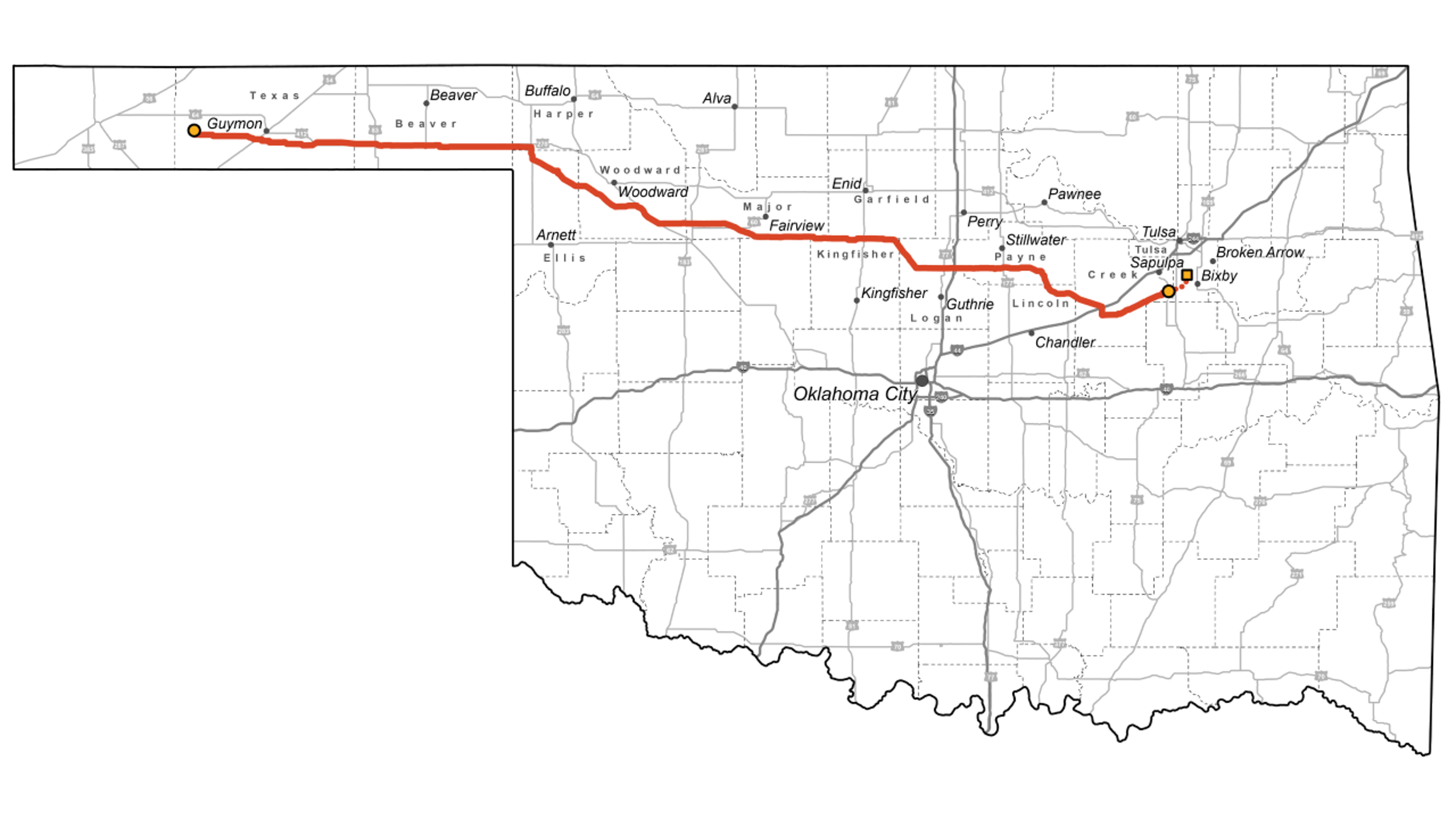
The project called for the transportation of wind-powered electricity across the state to the Riverside Substation in Jenks “to serve areas of growing demand.” Invenergy contended the project would benefit Oklahoma families and businesses by “creating a new pathway to market for new energy generation.”

- 1,900 megawatts of power capacity, equivalent to two new nuclear reactors
- Thousands of jobs supported
- Hundreds of millions of dollars in new local tax revenue
- Tens of millions of dollars in landowner easement payments
Cimarron Link was chosen in October of 2024 to enter award negotiations for a $306 million capacity contract as part of the U.S. Department of Energy’s Transmission Facilitation Program. Invenergy contended at the time that the project would be able to transmit 1,900 megawatts of energy capacity which was equivalent to the size of two new nuclear power plants.
“The selection of Cimarron Link to enter award negotiations through the Transmission Facilitation Program is an important step to deliver Oklahoma power, benefitting Oklahoma families,” said Shashank Sane, Executive Vice President and Head of Transmission at Invenergy. “The strong support for this project at the local, state, and national level reflects the critical need this grid investment serves for Oklahoma, as it will enable the construction of energy infrastructure that the Panhandle has long sought.”
“Oklahoma’s welcoming business climate has created an increase in new and existing manufacturers looking to locate or relocate, but without projects like Cimarron Link, Oklahoma will not be able to bring this business diversity and economic vitality to the state,” said Ken McQueen, who was the Oklahoma Secretary of Energy & Environment at the time of the announcement.
Cimarron Link would generate more than 3,600 construction jobs and more than 20 permanent jobs once the project is operational. Additionally, as part of its capacity contract application, Cimarron Link presented a Community Benefits Plan to invest an additional $10 million in Oklahoma communities. This investment will enable local, Tribal, and disadvantaged communities to access jobs, workforce development opportunities, career pathways in renewable energy, and contracting opportunities for minority and disadvantaged business enterprises while also enhancing the state’s wildfire mitigation capabilities.
“Rarely does an infrastructure project provide so many tangible benefits to so many counties and citizens across one state,” said Oklahoma Senator Casey Murdock when the announcement was made.

“In addition to the direct benefits Cimarron Link will bring to landowners, schools, and county services, our state will benefit exponentially from the $10 million investment in our local communities.”
High Plains Technology Center stated in its letter of support, “Our number one focus is returning people to our communities while providing technical trades training that can provide meaningful income and opportunity for the people of our area. High Plains will continue to expand (our) programs to support the growth in workforce needs created by Invenergy’s investment and resulting from the Cimarron Link project.”
The Oklahoma Manufacturing Alliance stated in its letter of support, “In addition to addressing critical infrastructure needs, the Cimarron Link project will improve the lives of local communities by providing good paying jobs and workforce development opportunities.”
Funded through the Bipartisan Infrastructure Law, the Transmission Facilitation Program (TFP) is a $2.5 billion revolving fund that will provide transmission developers with financial assistance to help develop transmission infrastructure. The Transmission Facilitation Program is not associated with the National Interest Electric Transmission Corridor (NIETC) Designation Process or the preliminary designation of the Delta-Plains Corridor.