
Oklahoma Aluminum Project Grows With New Smelter Partnership
Nearly nine months after Oklahoma announced plans for construction of a $4 billion aluminum smelter in Inola, another major development signals the project is moving into a new phase.
Emirates Global Aluminium (EGA), the company that signed an agreement with Oklahoma Gov. Kevin Stitt last year, has entered into a joint development agreement with Century Aluminum Company to build what will be the first new primary aluminum production plant in the United States since 1980.
Under the agreement, Emirates Global Aluminium will own 60% of the joint venture, while Century Aluminum will hold a 40% stake. Company officials described the project as the single largest investment ever made in the U.S. aluminum industry.
Production Scale and National Impact
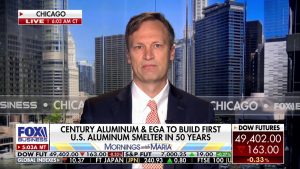
Century Aluminum CEO Jesse Gary told Fox Business News on Tuesday that the facility, once completed, will produce 750,000 tons of aluminum per year, a volume he said would more than double current U.S. aluminum production.
Gary said the Chicago-based company spent two years searching for a site capable of supporting the scale and power demands of a modern aluminum smelter before unveiling its plans.
Rather than constructing a standalone plant, Century opted to partner with Emirates Global Aluminium, making the Oklahoma project the first new aluminum smelter built in the U.S. in nearly half a century.
Gary credited President Donald Trump’s trade and industrial policies for revitalizing domestic aluminum production.
“Before President Trump came into office in his first term, the aluminum industry in the United States was on its knees,” Gary said. “We’ve gone from 30 smelters in this country down to just four.”
Federal Support and Expansion Elsewhere
The project has received a $500 million grant from the U.S. Department of Energy, reinforcing its national significance.
Gary said Century is also expanding production at its Mount Holly, South Carolina smelter, where output has already increased by 10%.

“After President Trump put the Section 232 tariffs on in his first term, we increased production,” Gary said. “And again, when he came back into office, we’re now increasing production again.”
Oklahoma as an Aluminum Manufacturing Hub
Gary said the company views northeast Oklahoma as a long-term center for aluminum manufacturing and downstream investment.
“So, first of all, Governor Stitt has been involved since the very beginning,” Gary said. “We really couldn’t ask for a better partner than the great state of Oklahoma.”
He added that the project is expected to operate for more than 50 years, with construction anticipated to begin by the end of the year.
Gary said the smelter could spark the development of an aluminum manufacturing cluster near Tulsa, drawing additional businesses and creating thousands of jobs across the region.
Power Supply and Utility Negotiations
The project’s scale has raised concerns about the availability of electric power, as aluminum smelting is one of the most energy-intensive industrial processes.
Public Service Company of Oklahoma (PSO), which serves the Inola area, remains in negotiations over a long-term power contract for the facility.
PSO previously cited a large industrial customer as a driver behind its acquisition of the 795-megawatt Green Country gas-fired power plant south of Tulsa, a move aimed at meeting rising demand.
Incentives and Global Competition
Oklahoma’s agreement with Emirates Global Aluminium includes more than $275 million in incentives, as well as discounted power rates.
As Canary Media reported, EGA originally proposed building its own Oklahoma smelter last year. Until this week, EGA and Century Aluminum appeared to be pursuing separate U.S. projects, before ultimately deciding to collaborate.
The partnership highlights broader challenges facing manufacturers worldwide, particularly the difficulty of securing large volumes of affordable electricity, a challenge intensified by growing competition from AI data centers.
Century Aluminum operates facilities in Hawesville and Sebree, Kentucky; Mount Holly, South Carolina; and Grundartangi, Iceland, with corporate headquarters in Chicago. The company also owns a carbon anode production facility in Vlissingen, Netherlands.