


Retired Military Aircraft Engines Could Offer Massive Power Potential
When U.S. military aircraft are retired from service, many are sent to the sun-drenched desert of southern Arizona, where they are stored at Davis-Monthan Air Force Base in a facility widely known as the Boneyard. Officially operated by the 309th Aerospace Maintenance and Regeneration Group (AMARG), the site serves as the final stop for thousands of aircraft — some preserved for potential reuse, others stripped for parts, and many simply stored indefinitely.
Today, more than 3,000 military aircraft, along with approximately 6,100 aircraft engines, sit in storage across the Boneyard’s 2,600 acres. While the aircraft themselves are largely dormant, a new analysis suggests the engines that once powered them could represent a vast — though largely theoretical — source of electricity generation.
Data Centers Drive Demand for Fast, Deployable Power
As data centers, particularly those supporting artificial intelligence, expand at an unprecedented pace, operators are struggling to secure electricity quickly enough to keep up. Traditional power plants and transmission upgrades often take years to permit and construct, pushing developers to search for rapidly deployable generation sources.
In recent months, some data centers in Texas have begun using modified jet engines — adapted from aircraft designs — as on-site generators. Each of these units can produce approximately 48 megawatts (MW) of electricity and can be deployed far faster than conventional infrastructure.
This trend prompted researchers at the U.S. Energy Information Administration (EIA) to explore whether engines sitting idle at the Boneyard could offer similar power-generation potential
EIA Estimates Up to 40,000 MW in Theoretical Capacity
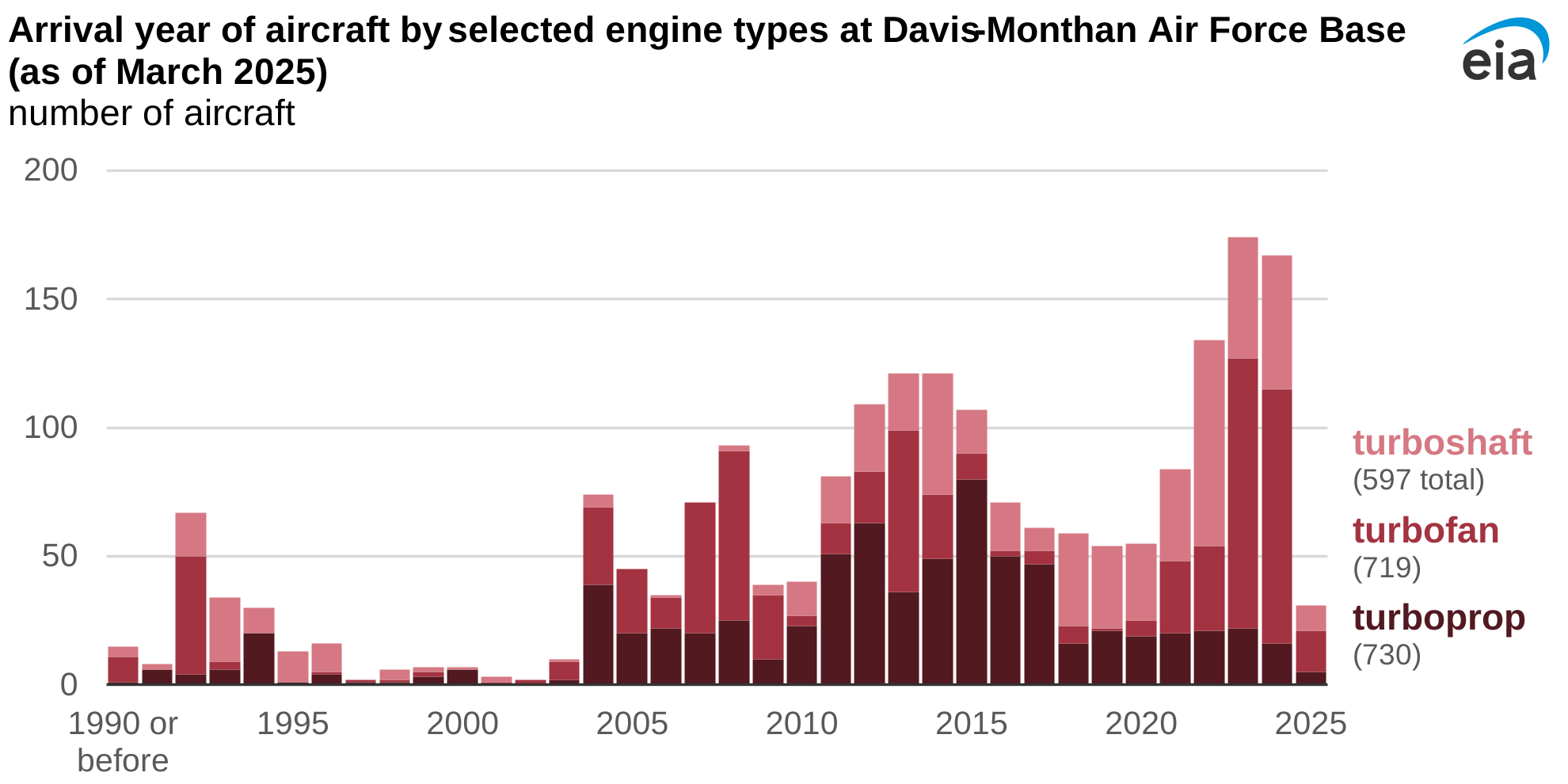
Using March 2025 inventory data published by AMARG, EIA researchers calculated that the engines stored at the Boneyard could theoretically provide as much as 40,000 megawatts of generating capacity. That amount would equal roughly 10% more than Arizona’s current installed electricity generation capacity.
However, the EIA stressed that this estimate reflects theoretical maximum output, not a realistic deployment scenario.
“This is not a feasibility study,” researchers emphasized, noting that their calculations do not account for engine condition, military mission needs, or the complexity of converting aircraft engines into stationary power generators.
Understanding the Engine Types in the Boneyard
The aircraft in storage at Davis-Monthan were powered by four primary categories of turbine-based engines:
-
Turbojets
-
Turbofans
-
Turboshafts
-
Turboprops
While all four types can technically generate electricity, EIA researchers determined that not all are practical candidates.
Why Turbojets Were Excluded
Turbojet engines, common in older military aircraft, were excluded entirely from the analysis. These engines are widely regarded as inefficient by modern standards and would consume far more fuel per unit of electricity generated than newer technologies.
Researchers also excluded afterburning turbofan engines, whose structural design differs significantly from engines typically used in power generation.
“We haven’t included any generating capacity from turbojets or afterburning turbofans in our calculations,” the EIA stated.
Turbofan Engines Hold the Greatest Promise
The largest share of potential capacity comes from turbofan engines, which account for an estimated 32,000 MW of the total theoretical output.
Turbofan engines are particularly attractive because they already serve as the basis for aeroderivative combustion turbines, which are widely used in utility-scale power generation today. These turbines adapt aircraft engine cores for stationary electricity production.
To estimate conversion potential, EIA researchers compared the GE Vernova LM6000 — a commercial aeroderivative turbine — with the GE Aerospace CF6 turbofan engine it was derived from. Refurbished CF6 engines are already available on the aftermarket, suggesting conversion is technically feasible.
Still, the researchers cautioned that factory-designed turbines are more optimized for power generation than retrofitted engines, and conversion would require:
-
Engine removal from storage
-
Refurbishment and inspection
-
Adaptation to natural gas or distillate fuel oil
-
Integration with generators and controls
Each step adds cost and complexity.

Turboshaft Engines: Limited Capacity, High Complexity
Turboshaft engines, commonly used in military helicopters, resemble smaller natural gas combustion turbines already operating across the U.S. grid. According to EIA estimates, approximately 1,100 turboshaft engines in the Boneyard could provide about 1,600 MW of cumulative capacity.
One example cited was the MH-60 Seahawk helicopter, which uses two General Electric T700 engines, each rated at 1.2 MW. With 65 retired MH-60s in inventory, EIA calculated a combined potential of 156 MW from that fleet alone.
Despite this, researchers noted that the average capacity per engine — less than 1.5 MW — may not justify the cost of removal and conversion, particularly when modern reciprocating engines in the same power range are more efficient and easier to deploy.
Turboprop Engines Add More Capacity — With Caveats
Turboprop engines, such as those used in C-130 Hercules cargo aircraft, also present potential. After converting their horsepower ratings, EIA estimates that up to 7,300 MW of capacity could theoretically be available from the roughly 2,300 turboprop engines in inventory.
As with turboshafts, however, the economic case remains uncertain due to refurbishment costs and logistical hurdles.
Oklahoma’s Connection to the Boneyard
Although the Boneyard itself is located in Arizona, it has a direct Oklahoma connection. AMARG operates as a geographically separated unit of the Ogden Air Logistics Complex at Hill Air Force Base in Utah, but it falls under the authority of the Air Force Sustainment Center, headquartered in Oklahoma City.
That connection places Oklahoma at the administrative center of any future decisions involving engine reuse, logistics, or potential civilian energy applications.
A Massive Resource — But Not a Simple Solution
EIA researchers concluded that while the Boneyard represents a remarkable concentration of dormant energy potential, turning that potential into real-world electricity would require overcoming substantial technical, economic, and policy barriers.
The analysis highlights both the scale of America’s growing electricity challenge and the unconventional solutions being explored as data centers, AI infrastructure, and industrial demand continue to accelerate.