

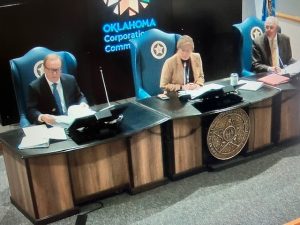
Oklahoma Corporation Commissioner Todd Hiett stuck to his convictions and vowed publicly at Thursday’s meeting he will not recuse himself from an Oklahoma Gas and Electric Company rate case—a recusal pursued by the utility.
“I find it to be very disturbing OG&E is attempting to intimidate and squelch the voice of a regulator to do his job,” he read from notes as the recusal matter was part of the commission’s agenda for the meeting that became contentious.
OG&E had filed the request after Hiett opposed its expanded energy projects case which commissioners voted 2-1 last month to support with Hiett dissenting. Hiett explained at the time he supported the original order drawn by Commissioner Brian Bingman because it contained consumer protections, but could not support a redrawn order because it did not include the protections. The order allowed pre-approval of costs of the projects but excluded any CWIP or Construction Work in Progress costs to be passed along to ratepayers.
“My colleagues and future commissioners should be greatly concerned because if they can do it to me, they’ll do it to you,” warned a defiant Hiett who also pointed out the Supreme Court had already made it clear there was “no legal basis” for such a request by the utility. He cited previous such rulings by the Supreme Court and further stated, “the law is clear…bias does not require recusal.”
Hiett called OG&E’s request “absurd” and “without legal merit” for the utility to “intimidate and quiet a single commissioner.” During his several-minute long statement, Commissioner Hiett recalled his criticism of the utility at two meetings in November and said he had called OG&E “out for deceptive information.” He said he had questioned the numbers “as is my job.”
“I pointed out OG&E worked behind the scenes to make the final order more favorable to them,” said Hiett, adding that 59 out of the 78 points in the original order drawn up by Commissioner Bingman were eventually changed after OG&E offered comments.
“I will not recuse from this case. I do not have a bias,” he continued, adding he actually thinks highly of the company, OG&E.
“I’ve done my job and I won’t apologize,” added Hiett, stating he had been “ostracized by OG&E.” The commissioner said in conclusion that what OG&E had done was “send a chilling message—do what we want or else.”
OG&E Senior Regulatory attorney Chase Snodgrass, the former Deputy Attorney General who took an OG&E job as a Senior Regulatory Attorney in July, attempted to offer an immediate response, but Hiett added the comments were his posting. An attorney with the commission’s General Counsel pointed out the matter was only for comment by Hiett and did not involve a vote.
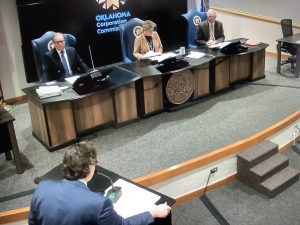
“It’s our right to respond,” argued Snodgrass. “OG&E deserves an opportunity to respond to Commissioner Hiett’s comments.”
“It’s not what I want—it’s what is legal,” snapped Hiett in reply. “I don’t think it’s proper and legal for them to do so.”
After discussion with Commissioners Kim David and Brian Bingman, it was decided OG&E would not be allowed to comment but could make a response in a filing in its case.
“You can respond in writing,” declared Commission chair David. “At this time, it’s not appropriate.”
“Let me be clear—you’re not allowing us to respond?” asked Snodgrass, almost in disbelief.
“That is correct,” stated David.
Commissioners then listened to arguments by Oklahoma Industrial Energy Consumers and the AARP to have the final order in the OG&E rate case rewritten. The two organizations filed a motion last month for such a change and on Thursday, OIEC Executive Director Thomas Schroedter argued, “Your final order doesn’t offer up any consumer protection.” He proposed the commission reconsider the original order drawn by Commissioner Bingman.
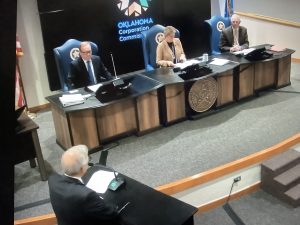
Schroedter was again critical of the final bids OG&E had used in its natural gas project at its Horseshoe Lake power plant in eastern Oklahoma County. He contended the utility did not accept the low bids and instead chose prices that resulted in 40% higher costs. He also objected to the final order’s exclusion of any mention of OIEC’s original arguments and testimony.
“There was no reference to OIEC. It’s as if it didn’t participate,” he quipped and later told commissioners “OG&E is wrong on the law.” He urged the commissioners to rewrite the order in the public interest.
Snodgrass responded in defense of the order and the actions of OG&E. He contended OIEC and AARP were simply attempting “to re-argue the case” and what they were seeking “didn’t require reconsideration on any legitimate ground.” The utility attorney also argued the final order and agreement “had consumer protections.”
Snodgrass also denied the utility helped rewrite the final order, explaining it simply offered recommendations to Commissioner Bingman’s office just as the OIEC did.
“That’s untrue,” he said of the OIEC’s claim the utility had rewritten the final order. “This is routine. We just provided recommendations.”
Snodgrass then accused Commissioner Hiett and OIEC attorney and director Thomas Schroedter of “manipulation” of what occurred.
“It’s further evidence of why Todd Hiett’s bias shows he should not be in this case.”
Commissioners agreed to take the OIEC and AARP request under advisement.