
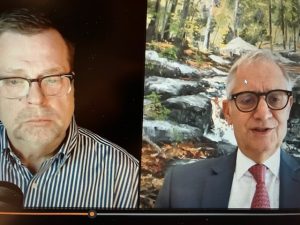
Months after suggesting to Oklahoma Corporation Commissioners that the state’s CWIP law, one that originated from SB998, was likely unconstitutional, attorney Thomas Schroedter believes there will be a constitutional challenge in 2026 before the state supreme court.
He says such a challenge relies on the actions of the Corporation Commissioners who recently were presented with Construction Work in Progress tariff requests by two major utilities, Oklahoma Gas and Electric Co. and Public Service Company of Oklahoma.
“Yes, I do,” he told Scott Mitchell in a recent interview for OK Energy Today. “If the Oklahoma Corporation Commission issues an order approving C-WIP, which I hope they don’t, I hope the Corporation Commission determines that the statute is unconstitutional.”
Schroedter, executive director and attorney for the OIEC or Oklahoma Industrial Energy Consumers explained it is dependent on the action of the regulators.
“But if they don’t, you will see an appeal before the Oklahoma Supreme Court once a commission order is entered and that will likely be this year—next year 2026. So yes, you’ll see that coming.”
Recent CWIP requests were filed by Oklahoma Gas and Electric Co. and PSO.
OG&E asked for CWIP in its use of natural gas combustion generators at the utility’s Horseshoe Lake Power Plant in eastern Oklahoma County. The utility pointed to the state’s new CWIP law.
“In filing for the request, (Case 2025-000082) the utility pointed to a new law that originated from SB998, which went into law at the end of August and applied to energy projects that involve the use of natural gas for power.
“The Commission shall permit an electric utility to begin to recover return on and return of Construction-Work-In-Progress expenses prior to commercial operation of a newly constructed electric generation facility subject to the provisions of this subsection, provided the newly constructed electric generation facility utilizes natural gas as its primary fuel source. The Commission shall permit a separate rate adjustment mechanism, adjusted periodically, to recover the costs described in this section for new capacity in natural-gas-fired electric generation facilities.” 17 O.S. § 286(C)(6),” stated OG&E in the filing with the Corporation Commission.

SM: Tom, good morning. Merry Christmas to you. Scott, good morning.
Merry Christmas to you. Let’s start with non-docs doing a really great job on trying to understand how this this CWIP is and of course Jerry Bohnen over at OK Energy Today. We’ve been talking about this for a very long time and people are starting to focus on, hey this impacts me.
One of the things that we’ve sort of set up as a kind of a crutch has been like CWIP is basically, and we know the utility is under intense pressure, okay. We know electricity demand, what’s
going on, regenerative AI and data centers, all that. Ad nauseum we’ve talked about that. But CWIP basically is putting on consumers credit cards future construction which has to be
done. But one of the things I wanted to ask you about is a term that’s basically most reasonable, lowest cost, all of the sort of stuff about what utilities are supposed to do, looking out for consumers. You have big consumers but help us just get started about what needs to be done, the discussion that’s going on about lowest cost, most reasonable rates, those sorts of things.
Help us out.
TS: Yeah, sure. So the Oklahoma Constitution, Article 9, Section 18 says that the Commission, Corporation Commission, is obligated, authorized to determine fair, just and reasonable rates for Oklahoma utilities. And the courts have said that that means lowest reasonable rates. So the Corporation Commission has a duty to establish lowest reasonable rates. And the utility also has a duty to offer the lowest reasonable rates for their customers.
So that’s the standard in Oklahoma. That’s the standard across the nation. And in fact, that’s what my organization, Oklahoma Industrial Energy Consumers, advocates for. That’s why we exist, to advocate for lowest reasonable rates. We’re not the only consumer group that does that.
Of course, AARP is in the mix, intervenes in cases. They advocate for lowest reasonable rates. And that’s what Oklahomans want. No customer wants to pay more than their fair share. No customer wants to pay more than lowest reasonable cost. Now, as I said previously, this is all, the costs are going up and there are mixes. Oklahoma is not an island because we’re part of SPP.
SM: So I believe that’s called an RTO, Regional Transmission Organization. And these organizations, Tom, they deploy the cheapest energy, right? I mean, it’s a mix. They all have to have what’s the cheapest. And that all works into sort of the controversy that we’re reading about, correct?
TS: That’s correct. So the SPP schedules the resource based on the cost and they strive to ensure that lowest reasonable costs are what the consumers get. But on the other hand, the utility also has a duty when they’re adding resources to their system to select the resource that’s the lowest reasonable cost.
SM: That’s been an issue here of late with both OG&E and PSO. And you may have read about those cases. I think you have.
And that’s been a controversy, whether the utility is selecting the lowest reasonable cost resource. That’s one issue that we’ve been very much involved in. There is some controversy behind the governor’s energy agenda, which is everything, all resources forward now. And we have some very partisan issues that are ideological out there. You’ll have groups on the extreme, some that just want to do with oil and gas industry. Then there are extremes on the other end. Populism, I’m not sure that’s right or left. But then there are groups out there that just want to do away with renewables, both of which are unwise in the current environment in which we see necessary to get all the electrons we have. How does that complicate it? How does that complicate the situation we’re dealing with politically as well as economically?
TS: Yeah, that’s a really good question. So let me be clear about OIEC’s position in this regard. And I think it used to be the position of the Oklahoma legislature as well. And that is that the utility should select the lowest reasonable cost resource, whatever that might be, whether it could be wind, it could be solar, it could be natural gas. In the future, it could be nuclear. But the duty is to select the lowest reasonable cost for
ratepayers. We shouldn’t be favoring, the state of Oklahoma should not be favoring one industry.
They shouldn’t be picking winners and losers. And that’s very important, Scott. And so you’ll see us advocate for whatever resource is the cheapest and the best for ratepayers. And unfortunately, we’re getting away from that a little bit. At the legislature, they seem to be wanting to pick winners and losers. And we’re not supportive of that.
SM: Very, very interesting. That’s become the Republican, a tussle inside Republican politics, because in the Reagan days, it was government stay out. Right. And the governor has said, we don’t want to pick winners and losers. We want to keep our
thumb off of the scale. But we see that. Solar, wind, we’re seeing a lot of push activism push back out there. There are a lot of folks who surmise that possibly that’s orchestrated. But nonetheless, is that difficult when you see this sort of anti-renewable aspect or all the way over to the folks that don’t want to do pipelines and want to do away with gas and oil and gas? That ultimately hurts the consumer, correct?
TS: Absolutely. It’s counterproductive not only to the consumer, but also to economic development efforts in Oklahoma. And there are customers that want renewable to meet their sustainability goals. And again, the concept of lowest reasonable cost, whether it’s solar or wind. I’ll give you an example, Scott. PSO has a case right now in front of the Corporation Commission, and they’ve selected three wind power purchase agreements. And the reason
they’ve selected that is because they’re lowest reasonable cost.
So that’s an example of a selection of a wind resource that’s based on the cost of the resource. And so that’s, you know, we support that. Even though it’s wind, we support that because Oklahomans don’t want to pay more than they should.
The rates are going up, as you said. And I don’t know, you know, Oklahoma’s competitive advantage is in jeopardy. We’re potentially going to lose the advantage we have of low electric
costs if we don’t pick the lowest reasonable cost. That’s going to go away. That’ll evaporate. And so we need to be careful. And the Corporation Commission needs to be very careful as well.
SM: A recent story that happened in front of the Corporation Commission, two to one, it was dealing with some new power plants coming online. Your organization opposed it. AARP opposed it. And what was the story behind that?
TS: Sure. There’s a lot going on in that case. There was a CWIP cost recovery request and also the request for approval of generating resources. So let me first deal with the generating resources, your question. So what happened in that case is OG&E selected the 26th best resource in terms of lowest reasonable cost, 26th. And that was the Horseshoe Lake units that OG&E is going to build. They were the 28th best in terms of cost. So there were 27 different options that were cheaper and there were 25 different options that were better.
And nonetheless, OG&E chose the Horseshoe Lake units. And the reason that they chose that or part reason is because they will make a substantial return for their shareholders by selecting an
option where they’ve got to make a $500 million investment. There were other options available to OG&E, such as a purchase power agreement for 10 years at a much lower cost, a 40% lower cost. And yet OG&E selected the Horseshoe Lake. And so OIEC and AARP opposed that. The corporation commissioned by a two to one vote with Commissioner Hyatt dissenting determined that OG&E’s selection was appropriate of Horseshoe Lake.
So after the commission entered its final order, Scott, OIEC and AARP then moved for reconsideration. And again, in our motion, we raised the issue of why are you selecting commissioners the 26th best option when you’ve got so many better options available for ratepayers? And they basically denied our request for reconsideration with Commissioner Todd Hiett dissenting. And Commissioner Hiett wanted to reopen the record and wanted to offer additional protections to ratepayers. But the other two commissioners did not want to open the record. So that was a concern. Now, the other concern in that case was the CWIP.
And I don’t know if you want me to go into that now or if you want to do it.
SM:I think it’s perfect to go time to go into that.
TS: All right. So OG&E also requested CWIP cost recovery. And as you mentioned, CWIP basically means that OG&E wanted to charge its customers for financing the cost of these Horseshoe Lake units. So in other words, customers would pay in their bills a rate increase for OG&E to build these units. And we would pay the financing costs of the construction of these units. That’s unheard of in Oklahoma. It’s never been the case that Oklahoma customers have had to pay for the financing costs. And that is, as you know, a result of Senate Bill 998. But we argued, OIEC and AARP argued that Senate Bill 998 was not effective when OG&E filed its case. And thus OG&E was not entitled to CWIP. What happened in this case is before we got to a hearing, there was a settlement entered into, a partial settlement. And that settlement involved OG&E, the Attorney General, and the Corporation Commission staff. And those parties recommended that CWIP recovery should be granted. And we fought that. And at the hearing on the merits, the Corporation Commission agreed with
us and said, no CWIP. And that was very unfortunate for us, that CWIP was not authorized. So the bottom line is we won the CWIP argument in that case. And the Corporation Commission did make a wise decision by saying that ratepayers wouldn’t have to finance a plant. But on the other hand, we lost the argument regarding the selection of the Horseshoe Lake units. And thus we’re going to have to pay for those units down the road.
SM: I know we’re time constrained. Let me ask you a couple of questions. One was in when I was reading Savage’s story, Trey Savage’s story, one of the utility spokespeople said, well, we’re looking in a way to save money for the consumers like large
loads tariffs. Who would do large load tariffs? Would that be the utilities or that Corporation Commission instigate that?
TS: Yeah. So the utility would develop it and seek approval from the Corporation Commission. My understanding is OG&E is developing a large load tariff, and they’re going to come to the
commission with that tariff and get approval of that. But let me just say one other thing about the CWIP. Think about this, Scott.
SM: So the large load is not yet not yet up and running in Oklahoma, right?
TS: In fact, OG&E CEO was just interviewed in a I think it was CNBC, where he said that the large load OG&E hasn’t signed
up any of the large load yet. OK, so it is negotiating for this large load. So if you impose CWIP costs on customers of OG&E and PSO, they will be paying for the costs of these plants that are
being built in part to serve the large load.
So so think about this. You and I and businesses that exist in Oklahoma, residential customers, senior citizens are going to be paying CWIP for the likes of Meta, Google, these large companies that are building facilities in Oklahoma in the future. So we will be paying for the costs of these plants to serve the large load. That’s not right. And so if there’s something I can leave you with today, the legislature, the Oklahoma legislature, needs to go back and amend or repeal the CWIP law, because the CWIP law is not beneficial to customers. It will not save customers money.
It will cost customers money. And that’s the fallacy of this. And the legislature’s the legislature, or at least the majority of the legislature and the leadership, I think, was falsely influenced by
an argument that CWIP will save money. And it’s not going to save money. It’s going to put the burden on you and I and the existing
customers to pay for these large loads that are going to come on to OG&E and PSO system. And that’s simply in right.
SM: Final question. So much more I want to get back with you again on behind the meter and things of that nature. But taking into account that everything you say is true, why has there not been some sort of lawsuit challenging CWIP? All three commissioners, as I recall very clearly, all three commissioners last year said it’s probably unconstitutional. Right. And there were people who were urging the governor to veto it. It actually went into law without his signature. Do you think we’ll see some legal challenge to CWIP?
TS: Yes. Yes, I do. If if if the Corporation Commission issues an order approving CWIP, which I hope they don’t, I hope the Corporation Commission determines that the statute is unconstitutional. But if they don’t, you will see a an appeal before the Oklahoma Supreme Court once a commission order is entered. And that will likely be this year. I’m sorry. Next year, 2026. So, yes, you’ll see that coming.
SM: Well, this is very in the weeds, but it becomes less in the weeds when people go and open up or go online and see their bill.
Exactly. I mean, that’s exactly what’s going on. Oh, yeah.
Yeah. Yeah, exactly. By the way, we’ll say this Horseshoe Lake plant comes on.
Is that the sort of how much of that plant’s energy would be deployed by SPP just in general? Is it going to be pretty consistent or is it intermittent? You know, we hear renewable say it’s
intermittent, but SPP deploys things intermittently. Correct. Am I wrong?
TS: No, no, no. That’s a really good question. And I should address that. The plant that is building is a peaker plant. So, in other words, that that plant is not going to run all the time. In fact, that plant is going to run very little. It’s a it’s a plant that is serving the capacity needs of but it’s it’s a backup plant that’s going to be run in peak periods. So very, you know, maybe 10 percent of the time that plant will operate. SPP will call on that plant during peak periods when households are home, when the lights are on, when dinner is
being served, when they’re washing clothes, that sort of thing. So it’s not going to be run all the time.
And so it’s not going to burn a lot of natural gas either. It’s going to be, you know, very, very intermittent and very little gas supply being burned.
SM: Thomas Schroedter of OIEC and Hall Estill, I think that probably you’ve raised more questions and we’ve had answers today in limited time. I thank you very much for your time. I think this is one of those. Jerry and I’ve been saying for some time there is a there’s some demand right now.
And the demand is a lot more media scrutiny of what’s going on out there. It just it just seems to be something that it’s going to impact every single human being in our state, in our region.
And, you know, we get more weather information than we do stuff about this.
TS: Sure. And I appreciate you following this. And, yeah, the idea is to to make the public aware of this issue.
SM: All right, Tom, we’ll look forward to talking to the utilities about their side of this. But anyway, at any rate, thank you for your time. And I’m sure we’ll be seeing you again.
TS: Thank you, Scott. Appreciate it.