


Without an explanation, the Oklahoma Corporation Commission on Tuesday fired Brandy Wreath as the agency’s Director of Administration, a position he held for the past two years.
The major question of “why?” was left unanswered and Commissioners gave no hint or explanation behind Wreath’s termination.
Commissioners took the formal action in a public meeting following a three and one-half long executive session. Around 5 p.m. the commissioners returned to the public meeting.
Commission Chair Kim David made the motion to “proceed with termination” of the director but did not state Wreath’s name. The commission vote was 3-0 as Commissioners Todd Hiett and Brian Bingman joined her in the move.
David stated publicly the commission, during its executive session held a discussion of “several options” and she moved in support of “confidential severance options.” The vote to support was 3-0.
Then David explained the commission also discussed the hiring of an “interim director” at a “commensurate salary” of the director’s position. Commissioners voted 3-0 for the hiring but did not indicated who might take the position.
At 5:05 p.m., the commission adjourned the meeting and Commissioners Bingman and Hiett quickly departed while David was the last to leave the public session.
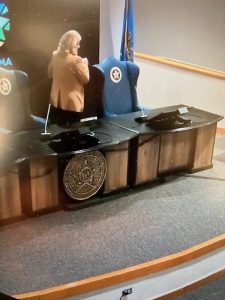
No explanations or statements were given at the meeting regarding why Wreath was terminated or fired from the job.
Joining the Commission in 2006, Brandy served as a PUD senior auditor and expert witness in multiple public utility cases. As PUD’s Chief of Energy, Brandy was appointed to the National Association of Regulatory Utility Commission’s (NARUC) subcommittee on natural gas and still serves in this capacity. He has represented NARUC as an international delegate to India’s Petroleum and Natural Gas Resource Board.
Wreath was appointed Director of Administration and Appointing Authority for the Oklahoma Corporation Commission (OCC) by Corporation Commissioners in June 2022 after serving for 10 years as Director of the agency’s Public Utilities Division. As Director, Brandy is responsible for the agency’s day-to-day operations including its four core divisions, overseeing an annual budget of $68 million, and redefining the agency’s workplace culture for its more than 550 employees, regulated companies, and Oklahoma’s four million-plus consumers.
Prior to coming to OCC, Brandy worked in the banking industry serving in sales, service, and management capacities. He graduated Magna Cum Laude from Mid America University in 1998 with a B.S. in Business Management and Ethics.
In October, Wreath went before a State House interim study hearing which examined the Corporation Commission’s regulation of the state’s oil and gas industry, including workforce challenges, orphan well plugging and seismic activity. Rep. Nick Archer, R-Elk City, led the study that he said was designed to give legislators and stakeholders a clear look at the OCC’s current operations, regulatory responsibilities and funding concerns.
A press release following the hearing stated, “One of the study’s central topics was delays to the protest docket, which is OCC’s process for hearing contested oil and gas cases. OCC’s Director of Administration Brandy Wreath said frequent continuances, attorney scheduling conflicts and a shortage of court reporters and judges have slowed the docket significantly. Since these cases can involve major projects and millions in production, delays on the protest docket can have a significant economic impact.”
Wreath added that both court reporters and judges who work on the protest docket are “grossly underpaid” and plans to ask for a legislative carveout to pay competitive salaries.
Archer asked how to prevent abuse of the protest docket system. He pointed to a large producer who is facing protests from entities that, rather than having an actual issue with the case, were instead trying to gain a better understanding of it.
Wreath said the Commission has done what they can to address abuse of the system, but they’re still limited by the lack of attorneys and judges.
The committee also reviewed induced seismicity and regulatory strategies. Wreath said that OCC, industry leaders and legislators need to work together to determine policies moving forward.
“I think it’s one area where we failed is one side of the equation comes up with an idea that we’re not all in agreement [with] when we leave the table,” he said. “Even if we don’t get what we want, we need to figure something out that every size of producer can agree to, that the Legislature can agree is right, the commissioners can agree, because they’re gonna be issuing the orders, and then we all leave with the same marching orders and say this is what we’re gonna do as a state.”
A spokesman for the Corporation Commission explained this week following Wreath’s firing, “the remarks were not about challenges agency-wide or pertaining to the Public Utility Division. The interim study was focused on the Oil and Gas Conservation Division, and which is mostly funded through state appropriations. The comment regarding challenges was referencing this sole division. OCC experienced a two percent cut in annual appropriations for FY2026.”
Wreath was not named in the most recent Supreme Court filing regarding three Republican legislators who have challenged the votes of Corporation Commissioner Todd Hiett over some of his past social errors including public drunkenness and alleged attempts to grope a man at a bar. The legislators did identify Wreath by his position at the agency and blamed him in part for the hiring of a college dropout who conducted audits of some of the recent rate hikes approved for utilities.
“There are serious concerns about how the Corporation Commission is operating,” Kevin West said. “We have asked the Supreme Court to intervene regarding flawed audits and due process issues, but its role is necessarily limited.”
In September, the OCC’s director of administration told House members that recent challenges stemmed from staffing shortages.
“In order to protect ratepayers and maintain public confidence and transparency, the Legislature will have to step in and ensure proper procedures are being followed,” Kevin West said.
All told, Rep. Tom Gann, Kevin West and Rick West’s filed and pending appeals challenge more than $11 billion in utility charges for ONG, OG&E and PSO.
An Oklahoma Energy Producers display of Wreath’s bio stated, “Brandy is a natural innovator in promoting an employee-centered workforce and, as a public servant, is a huge proponent of transparency – especially in the expenditure of public funds and agency operations. He is adept at putting people in positions that match their personal skills, experience and education which in turn benefits the employee, OCC, and all Oklahomans. OCC
impacts the lives of every Oklahoman every single day and this responsibility is at the forefront of his management decisions.”