
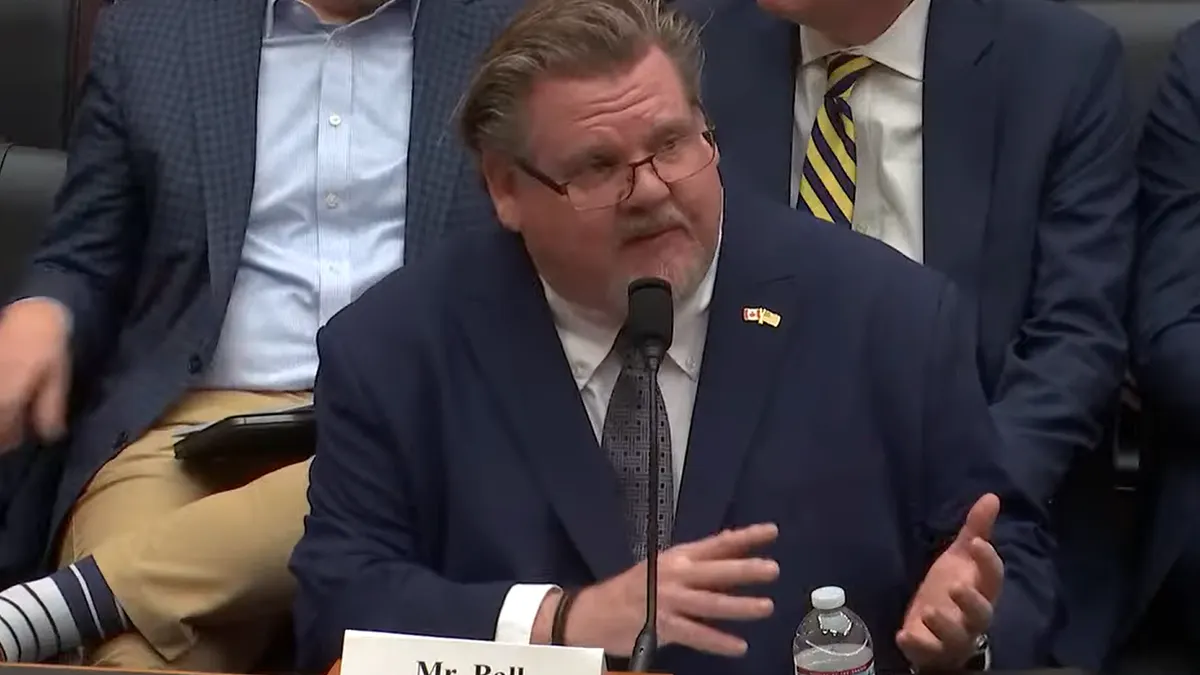
Michael Ball, CEO of the Electricity Information Sharing and Analysis Center and senior vice president at the North American Electric Reliability Corp., speaks at a hearing held by the House Energy and Commerce Committee’s energy subcommittee in Washington D.C. on Dec. 2, 2025. Retrieved from U.S. House Energy and Commerce Committee.
U.S. Grid Threats Highlighted During Congressional Cybersecurity Hearing
Members of a key congressional committee were warned this week that China’s spying and cyber-intrusion efforts against the United States remain active, particularly in attempts to identify weaknesses in the nation’s power grid and critical network systems.
The testimony was delivered before the U.S. House Energy and Commerce Committee’s energy subcommittee, a panel that historically included influential Oklahoma lawmakers. The latest hearing focused on emerging threats to America’s energy infrastructure, a concern that has grown as cyber operations by foreign adversaries become more sophisticated.
Volt Typhoon Identified as Major National Security Concern
E-ISAC CEO Michael Ball Warns of Active Chinese Intrusions
Michael Ball, CEO of the Electricity Information Sharing and Analysis Center (E-ISAC) and senior vice president at the North American Electric Reliability Corp. (NERC), told lawmakers that a Chinese-linked hacking group known as Volt Typhoon continues targeting U.S. energy networks.
Ball described Volt Typhoon as a People’s Republic of China state-directed unit that “focuses on maintaining ongoing access to U.S. network systems” for potential future disruption campaigns. He emphasized that this activity is not hypothetical — it represents a persistent effort to map, infiltrate, and quietly monitor American electric infrastructure.
Additional Expert Testimony: China Prepares for Possible Conflict Over Taiwan
Harry Krejsa, director of Studies for the Carnegie Mellon Institute for Strategy & Technology, echoed the warnings during his own testimony. He explained that as China prepares for a potential conflict involving Taiwan, its strategy depends heavily on the ability to delay or weaken U.S. military response.
According to reporting from Utility Dive, Krejsa stated that part of that strategy includes probing American infrastructure — including energy systems — to determine where disruptions could slow down U.S. mobilization or create domestic instability at critical moments.
Context for Oklahoma
While Oklahoma has no current members on the committee, the state is deeply tied to national grid operations as part of the Southwest Power Pool (SPP) and home to numerous gas, power, pipeline, and energy-intensive facilities. Any vulnerabilities in the national grid directly affect the reliability and security of power delivered to Oklahoma communities and major industrial users.
📌 MORE ENERGY NEWS
Get daily updates on Oklahoma’s power grid, drilling activity, federal policy changes, and national energy security developments.
Click here for Utility Dive